Article 13 of the EU Energy Performance of Buildings Directive (EPBD, Directive (EU) 2024/1275) requires non-residential buildings to be equipped with building automation and automatic lighting control with zoning and occupancy detection. The directive does not apply directly to building owners, however: it becomes binding only through the national law of each Member State – in Germany through the Buildings Modernisation Act (Gebäudemodernisierungsgesetz, GModG). This guide explains what Article 13 requires for lighting, how Germany has transposed it, why the often-quoted 2027 deadline does not apply in Germany and what companies with sites in several EU countries should consider.
What is the EPBD?
The EPBD (Energy Performance of Buildings Directive) is the central EU directive on the energy performance of buildings. The current recast is numbered (EU) 2024/1275 and has been in force since 28 May 2024. Member States had until the end of May 2026 to transpose it into national law.
A directive differs from a regulation: it is addressed to the Member States, not directly to companies or building owners. Each Member State decides within the framework how to implement it – with its own laws, terms, evidence requirements and, in some cases, deadlines. For operators, what matters is always the national law.
What does Article 13 require for lighting?
Article 13 deals with technical building systems and in particular building automation. For non-residential buildings, two elements are central:
- Building automation and control: systems that monitor and analyse energy use and operate the plant efficiently.
- Automatic lighting control: lighting should no longer be switched by hand only, but automatically – with appropriate zoning and occupancy detection.
Zoning means that not a whole floor or hall switches together, but individual areas separately. Occupancy detection means that presence or motion sensors detect whether an area is in use. The difference between the sensor types is explained in Presence vs. motion detectors.
How Germany transposed Article 13
Germany transposed the EPBD with the Buildings Modernisation Act, which replaced the Buildings Energy Act (GEG). The Article 13 requirements are found in Section 56 GModG:
| EPBD Article 13 | Transposition in Section 56 GModG |
|---|---|
| Building automation in non-residential buildings | Para. 1: from a system > 70 kW by 31 Dec 2029, with monitoring, analysis and an open interface |
| Automatic lighting control | Para. 6: from 70 kW by 31 Dec 2029, mandatory |
| Zoning and occupancy detection | Para. 6: as a "should" requirement, i.e. the standard case |
| New buildings | Para. 3: class C from 70 kW, class B from 290 kW, plus technical commissioning management |
The 70 kW threshold refers to the rated output of a single heating, air-conditioning or combined ventilation system – not to the lighting load. An overview of all German energy laws affecting lighting is given in German energy laws and lighting control.
Why the 2027 deadline does not apply in Germany
Articles, manufacturer documents and presentations often mention 31 December 2027. Industry sources quote this date at EU level for lighting control in buildings above 290 kW. Germany has not adopted it as a separate deadline. Under the GModG, automatic lighting control is due uniformly by 31 December 2029 – and already from 70 kW.
For German sites this means:
- There is no separate German lighting obligation for 31 December 2027.
- On the other hand, more buildings are affected, because the threshold is 70 kW.
- Starting just before the deadline risks bottlenecks in planning and installation – and gives away savings every month until then.
Sites in several EU countries
For companies with offices, warehouses or stores in several EU Member States, the EPBD is a common framework – but not uniform law. Thresholds, deadlines, evidence and exemptions can differ from country to country. A proven approach:
- Draw up a site list: all non-residential buildings per country with use, floor area and rated output of heating, air-conditioning and ventilation systems.
- Check the national transposition per country with local energy or legal advisers. Our EU country overview is a starting point.
- Set one technical standard: automatic lighting control with zoning, occupancy detection and energy monitoring meets the core of Article 13 regardless of national details.
- Plan for open interfaces so data can be integrated into each building management system, see BMS integration via BACnet, Modbus and API.
- Plan by the earliest deadline across all countries.
What Article 13 means technically
Whatever the country, Article 13 describes lighting that recognises by itself when and where light is needed – in other words smart lighting:
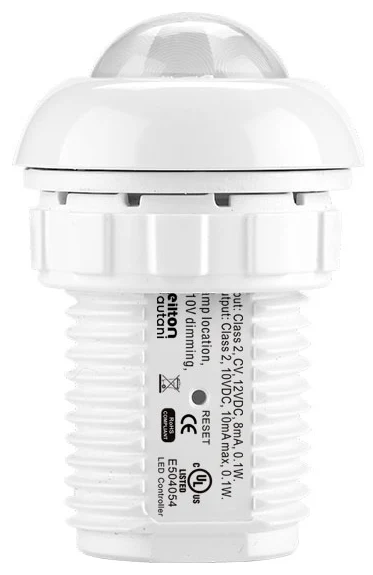
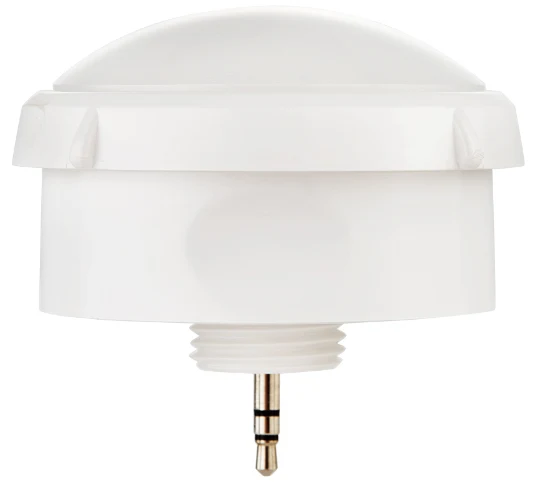
- Occupancy sensors per zone, matched to mounting height and use – for example the IFS105SE for 2 to 5 m or the EFS106 for 6 to 12 m.
- Daylight-dependent control where there are windows or roof lights, see Daylight harvesting.
- Energy monitoring that records consumption per zone, see Energy monitoring & BMS.
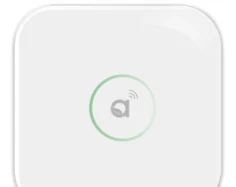
- Wireless networking without new control wiring, so existing buildings can be retrofitted quickly, see Bluetooth Mesh lighting control.
Retrofitting existing luminaires
Article 13 does not require new luminaires. Existing LED luminaires with a dimmable 0-10 V or DALI driver can be retrofitted with sensors on the luminaire; where high-bay drivers lack a 12 V auxiliary output, a sensor with its own power supply such as the EFS104 is used. How we check and carry this out is described under Lighting control retrofit.
How we support you
For your sites in Germany we survey the building, plan sensors and zoning in line with Section 56 GModG and show you the result in advance in 3D in Sensora. We usually carry out installation and commissioning ourselves, or your own electrical contractor can do so if you prefer. Every project runs with the AU-Manager, so occupancy detection, zoning and monitoring are included and data can go to building automation via BACnet/IP. For a specific project, please use our contact page.
Try it interactively
Sensor finder
Frequently asked questions
What does EPBD Article 13 require for lighting?
Article 13 of the EU Energy Performance of Buildings Directive (EU) 2024/1275 requires building automation and automatic lighting control with zoning and occupancy detection in non-residential buildings. It becomes binding for owners through national law – in Germany through Section 56 GModG. Status October 2026, not legal advice.
Does the EPBD apply directly to my company?
No. The EPBD is a directive addressed to Member States, which had to transpose it by the end of May 2026. What applies to you is national law – in Germany the Buildings Modernisation Act (GModG).
Is there a 2027 lighting deadline in Germany?
No. Industry sources quote 31 December 2027 at EU level for buildings above 290 kW, but Germany has not adopted it as a separate deadline. Under Section 56(6) GModG, 31 December 2029 applies from 70 kW.
Do I need new luminaires to comply?
No. Existing LED luminaires with a dimmable 0-10 V or DALI driver can be retrofitted with occupancy and daylight sensors and networked wirelessly – see Lighting control retrofit.