You specify lighting control in a product-neutral way by describing functions and performance characteristics instead of product names: occupancy and daylight control, zoning, background light and corridor function, energy monitoring, an open interface such as BACnet/IP, the type of networking, plus commissioning, documentation and training. Clear information on the existing installation, above all the LED drivers, is also essential. This guide explains what belongs in a bill of quantities and provides a neutral sample text that you can adapt and use.
What belongs in the bill of quantities
Existing installation and conditions
Many change orders arise because the existing installation is described vaguely. In the preliminary notes, state:
- luminaire types, quantities, wattage and mounting heights per area
- driver interface (0-10 V or DALI), whether a 12 V auxiliary supply (AUX) is present, and photos of the driver labels as an attachment
- room uses, operating hours and whether work takes place during operation
- access, elevating work platforms, obstacles such as high racking or machinery
Functions
- Occupancy detection with adjustable hold time and multi-level dimming instead of plain on/off
- Daylight-dependent control per luminaire or zone
- Zoning with freely configurable groups that can be changed without rewiring
- Background light and corridor function: neighbouring luminaires dim to a background level when occupancy is detected in a zone
- Schedules and manual control via switches
- Local autonomy: occupancy and daylight control continue if the connection to the central unit is lost
Networking and interfaces
In existing buildings, explicitly allow or require wireless networking so that no new control cables are needed. For connection to the building management system, BACnet/IP is widespread in non-residential buildings. Specify which data points must be provided. See BMS integration via BACnet, Modbus and API.
Monitoring
Require recording and display of lighting energy consumption and occupancy per zone, with data retention of at least one year and an export function. This proves the savings and provides data for energy audits and reports.
Commissioning, documentation, training
These services are often described too briefly. Specify what must be in place at the end: configured zones and profiles, a functional test per zone, a commissioning report, an as-built plan with sensor positions and zones, access credentials and training for the operating staff.
Sample bill of quantities text
The following text is a neutral sample for a wireless retrofit in an existing building. Adjust quantities, units and values to your project and fill in the placeholders in square brackets.
Preliminary notes
The scope of work is the retrofit of automatic, occupancy- and daylight-
dependent luminaire-level lighting control in [building/area]. Existing
LED luminaires have dimmable drivers (interface: [0-10 V / DALI],
12 V auxiliary supply: [yes/no/mixed]). Luminaire list and photos of the
driver labels are attached. The luminaires will be retained. No new control
cables between sensors, luminaires and central unit are planned; networking
is wireless (mesh network). Work takes place during operation in agreed
time windows: [time windows].
Mounting heights: [m] (offices/ancillary areas), [m] (hall).
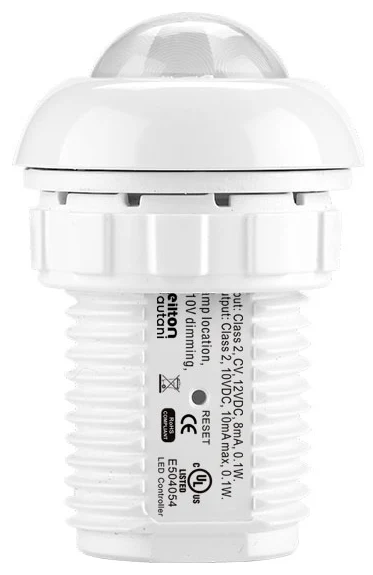
Luminaire-level sensor, indoor
Occupancy and daylight sensor for installation in or on the luminaire,
passive infrared detection, integrated daylight measurement, wireless mesh
networking, power supply from the luminaire driver or mains, driver control
via [0-10 V / DALI], multi-level dimming, hold time and dimming levels
adjustable via software, control continues autonomously if the central
unit fails, suitable for mounting heights up to [m].
Make: [to be stated by bidder] or equivalent.
Quantity: [pcs]
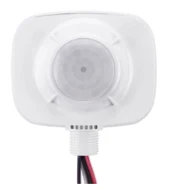
Sensor for high mounting heights
Occupancy and daylight sensor for mounting heights of [6 to 15] m, passive
infrared detection with lens suitable for high-rack aisles, wireless mesh
networking, control via 0-10 V. For luminaires without auxiliary supply:
sensor with its own mains supply and switching relay.
Make: [to be stated by bidder] or equivalent.
Quantity: [pcs]
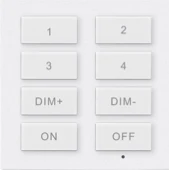
Wireless switch
Battery-powered wireless wall switch without cabling, functions on/off,
dimming and at least [number] scenes, assignment to one or more zones via
software.
Make: [to be stated by bidder] or equivalent.
Quantity: [pcs]
Central management unit with monitoring
Central unit for managing all zones of the building, with web-based user
interface, graphical display on floor plans, schedules, recording and
display of energy consumption and occupancy per zone, data retention of at
least 12 months, data export. Interface to the building management system
via BACnet/IP; data point list as per attachment [no.]. Including all
required gateways or zone interfaces.
Make: [to be stated by bidder] or equivalent.
Quantity: [1 pc / lump sum]
Background light and corridor function
Configuration of a background light / corridor function: when occupancy is
detected in a zone, defined neighbouring luminaires are dimmed to [%]; hold
time [min], then switch-off or background level according to the usage
profile. Lighting requirements under ASR A3.4 and DIN EN 12464-1 continue
to be met.
Lump sum
Commissioning, documentation, training
Commissioning of all components, forming zones and setting profiles
according to the agreed zoning concept, functional test per zone with
report, test of the BMS interface together with the BMS contractor.
Handover: as-built plan with sensor positions and zones, parameter list,
datasheets, access credentials. Training of operating staff, duration
[hours], with attendance list.
Lump sum
Optional: maintenance and support
Maintenance and support of the installation for [years], adjustment of
profiles when use changes, fault reporting with response time
[hours/days].
Contingency item.Common mistakes in tenders
- Only "presence detectors" specified, without dimming, daylight control and zoning
- Driver interface and auxiliary supply not stated
- Wired solution required although wireless would be cheaper and faster in an existing building
- BMS interface without a data point list
- Commissioning, documentation and training treated as an ancillary service without content
- No energy monitoring, although the savings are to be verified
Legal framework
Under § 56(6) of the German Building Modernisation Act (GModG), non-residential buildings with a heating, air-conditioning or combined ventilation system above 70 kW must be equipped with automatic lighting control by 31 December 2029; zoning and occupancy detection should be provided as a rule. A functionally described bill of quantities with these characteristics addresses the requirements directly. See German energy laws and lighting control. General information, not legal advice.
Conclusion
A good bill of quantities for lighting control describes functions rather than products, makes the existing installation clear and defines what must be in place after commissioning. With precise information on drivers, mounting heights and operating hours you receive comparable bids and avoid change orders.
How we can help
Our focus is retrofitting: we turn existing LED luminaires with dimmable 0-10 V or DALI drivers into smart lighting with sensors and app-based lighting management – without new luminaires and without new control cables. Details under Retrofit.
For planners, we provide datasheets and technical information on request and help with surveying the drivers. Installation is usually carried out by us, or by your own electrical contractor if you prefer. Every project includes the AU-Manager, so occupancy detection, zoning and monitoring are included, along with BACnet/IP for the BMS. Get in touch via our contact page.
Try it interactively
Grid planner
Frequently asked questions
How do I specify lighting control in a product-neutral way?
Describe functions and performance characteristics instead of product names: occupancy and daylight control, zoning, background light function, monitoring, interface and networking. If a product reference is unavoidable, add "or equivalent".
What belongs in a bill of quantities for lighting control?
Preliminary notes on the existing installation with driver interface and mounting heights, items for sensors, switches and the central unit, functions such as background light and corridor, monitoring, BMS interface, plus commissioning, documentation and training.
Should the lighting control in a tender support BACnet?
If a building management system exists or is planned, an open interface makes sense. BACnet/IP is widespread in non-residential buildings. Also specify which data points must be provided.
Can I specify wireless lighting control in a tender?
Yes. Especially in existing buildings it makes sense to allow or require wireless networking because no new control cables are needed. Specify that control continues locally if the connection to the central unit is lost.
What information on the existing installation do bidders need?
Luminaire types, quantities, wattage, mounting heights, driver interface (0-10 V or DALI), information on the 12 V auxiliary supply, photos of the driver labels, operating hours and access conditions.