In existing buildings, wireless is usually the more economical choice; in a new build or a major refurbishment with open ceilings, a wired bus such as DALI or KNX can make just as much sense. The biggest difference is not the technology but the installation effort: a bus needs a control cable to every luminaire and sensor, while wireless systems such as Bluetooth Mesh only need the existing mains supply. Both approaches control lighting reliably when properly planned.
The two approaches
Wired lighting control connects sensors, push buttons and drivers via a bus line. In lighting this is usually DALI; in wider building automation it is often KNX. The bus line forms the backbone that carries control commands and feedback. In a new build it is planned and installed with the electrical installation.
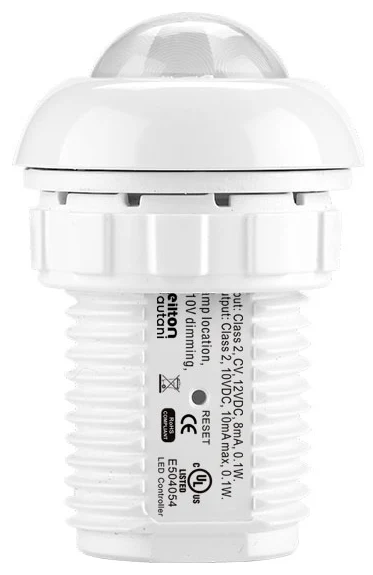
Wireless lighting control replaces the control cable with a radio network. With Bluetooth Mesh, every mains-powered device becomes part of the network and passes messages on to its neighbours. Sensors sit directly in the luminaire and are powered from the driver; battery-powered sensors and wall switches need no cable at all. How the network works is explained in Bluetooth Mesh in lighting control.
Comparison for existing buildings
| Criterion | Wired (DALI, KNX) | Wireless (Bluetooth Mesh) |
|---|---|---|
| Control cables | to every luminaire and sensor | none additional |
| Work on ceilings | opening, cable routes, possibly fire stopping | open luminaire, fit sensor |
| Disruption | usually greater, often areas closed off | brief, per luminaire or room |
| Main cost | electrical and ancillary work | hardware and commissioning |
| Change of use | groups via software, cable changes possible | groups via software, no cable changes |
| Dependence on radio environment | none | planning needed for concrete, metal racking |
| Battery replacement | none | only for battery-powered devices |
| Typical use | new build, major refurbishment, central BMS | retrofit during operation, halls, existing offices |
Looking realistically at cost drivers
With wired systems in existing buildings, installation costs often exceed the price of the control components themselves. Electrical work is joined by ancillary work: opening and closing ceilings, dust protection, fire stopping, scaffolding or elevating work platforms in halls, coordination with tenants and work outside operating hours. The higher the ceiling and the more intensive the use, the more these items weigh.
With wireless, the emphasis shifts: every controlled luminaire gets a sensor or node, and commissioning via app needs planning. In return, almost all cable installation disappears. A dimmable driver is required; if the 12 V auxiliary output is missing, there are alternatives, see The 12 V auxiliary output on LED drivers.
Disruption to operations
In offices, practices, warehouses or production, disruption is often the real bottleneck. For new bus cables, areas have to be cleared or work moved to weekends. A wireless retrofit is done luminaire by luminaire: open, connect the sensor, close. A room is usually finished quickly, and commissioning then takes place via app.
Flexibility
Both systems define groups and zones in software. If floor plans change, for example when an open-plan area becomes meeting rooms, wireless has the edge: the assignment is changed in the app and no cables need to be laid. With bus systems, reprogramming is often enough too, as long as the cable topology fits. If an area is re-divided and luminaires sit on different lines, cable work may be needed.
Reliability
Cables are independent of radio interference and wall construction. On the other hand, cable faults, wrongly connected terminals or overloaded bus power supplies can affect entire lines. A mesh network forwards messages via several devices; if one fails, messages take other routes. Its reliability depends on device density and planning: reinforced concrete ceilings, fire walls and metal racking attenuate radio and are taken into account in planning. Important for both approaches: with luminaire sensors, the occupancy decision is made in the luminaire itself, so the light continues to respond to presence even if communication is disturbed.
Combinations are possible
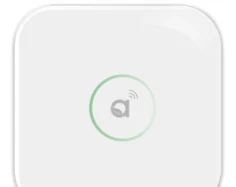
Wireless and wired are not mutually exclusive. A DALI or 0–10 V driver can sit in the luminaire while the sensors communicate wirelessly between luminaires. An existing DALI control system can be integrated or replaced depending on its condition, see Retrofitting sensors to DALI luminaires. In both approaches, connection to the building management system is usually via gateways; with wireless, for example via the AU-Manager with BACnet/IP, see BMS integration via BACnet and Modbus.
Decision guide
Wired fits well if ceilings are being opened anyway, a central bus infrastructure is planned, or radio communication is not wanted in certain areas.
Wireless fits well if the retrofit takes place during operation, the luminaires are already dimmable, halls with high ceilings are being equipped or spaces change use frequently.
Whichever route you take, control pays off: as a guideline from our projects, sensors alone save more than 60 % of lighting electricity; with daylight and background lighting up to 92 % is possible. For non-residential buildings with a heating, air-conditioning or combined ventilation system above 70 kW, Section 56 of the German GModG also requires automatic lighting control by 31 December 2029. General information, not legal advice.
How we can help
Our focus is retrofitting: we turn existing LED luminaires with dimmable 0-10 V or DALI drivers into smart lighting with sensors and app-based lighting management – without new luminaires and without new control cables. Details under Retrofit.
In existing buildings we rely on Bluetooth Mesh because it requires the least intervention, and we tell you openly if a bus line would make more sense in a particular area. Installation is usually carried out by us, or by your own electrical contractor if you prefer. Every project includes the AU-Manager, so occupancy detection, zoning and monitoring are included. Get in touch via our contact page.
Frequently asked questions
Is wireless lighting control reliable?
Yes, when it is planned. A mesh network forwards messages via several devices, so failures of individual devices are bypassed. Concrete, fire walls and metal racking are taken into account in planning. With luminaire sensors, the luminaire also responds to presence itself.
Which is cheaper in existing buildings: a DALI bus or wireless?
In occupied buildings usually wireless, because control cables, ceiling openings and ancillary work are avoided. With open ceilings in a major refurbishment, a bus line can be economically equivalent.
Can KNX and wireless lighting control be combined?
In principle yes. The connection is typically made via gateways or the building management system, for example via BACnet/IP. Which interface fits depends on the existing automation.
Do I need to lay new cables for wireless lighting control?
No. Sensors and nodes are connected in or on the luminaire and powered from the driver; battery-powered sensors and wall switches need no cable at all.
When is wired lighting control the better choice?
When ceilings are being opened anyway, a central DALI or KNX infrastructure is planned, or radio communication is not wanted in certain areas.